
PREFLOP · FIELD NOTE
Why position changes every preflop range
Stop memorizing isolated charts. Learn the pressures that make each seat open, fold, and fight back differently.
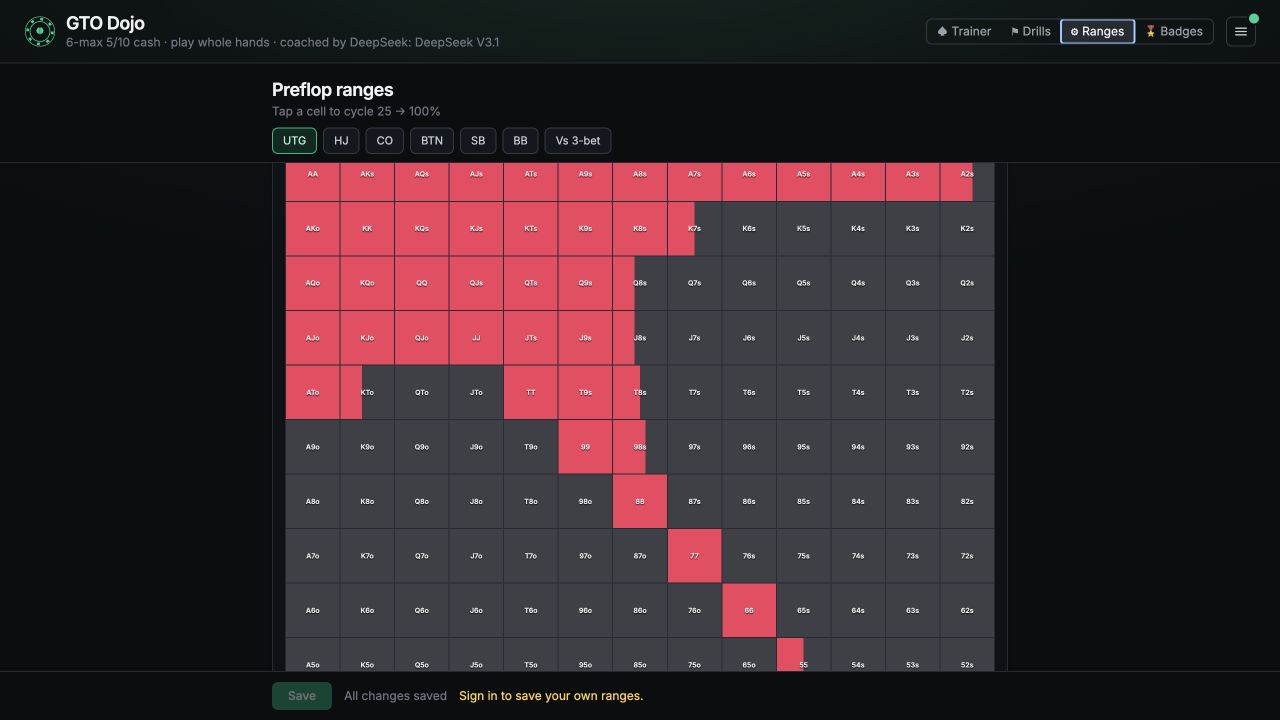
Preflop charts can look like a wall of disconnected facts: raise this hand in the cutoff, fold it under the gun, mix it on the button. Position is the rule that connects them.
The closer you are to the button, the fewer players remain who can wake up with a strong hand. You also have a better chance of playing postflop in position. Those two advantages let you enter the pot with more hands—and they change what everyone behind you is allowed to do in response.
The short answer
Open fewer hands when many players remain and more hands when only the blinds remain. Before raising a borderline hand, count who can still act and ask whether you will usually have position after a call. A hand can be a button raise and an under-the-gun fold without changing its raw strength.
Three useful words
Position means where you act relative to the other players; acting last after the flop is best. An opening range is the group of hands you raise when nobody has entered the pot. Realization describes how much of a hand's chance to win you can actually use. Acting last helps you reach later cards cheaply, control the pot, and make decisions after seeing what the opponent does.
Two quick examples
- Reasonable: It folds to you on the button with
K♥ 8♥. Opening to about 2–2.5 big blinds (2–2.5bb) is reasonable because only the blinds remain and the hand plays well in position when called. - Not reasonable: You open the same
K♥ 8♥under the gun at a full table because it was profitable on the button. Five players can still wake up with a stronger range, and you will often play out of position.
Practice this spot first
Decide whether king-eight suited opens on the button before viewing the hand. Afterward, move the same cards to the cutoff and then under the gun. Keep the stack and table tendencies fixed and predict where the hand first becomes a fold.
Dojo rule: Don’t ask whether a hand is “good enough to raise.” Ask how many players can punish the raise, and what position you will have if they call.
Start with the players left to act
An early-position raise must survive the entire table. That forces you to use stronger hands: good pairs, suited hands that can handle a reraise, and high-card hands such as ace-king or king-queen. K♥ 8♥ is a clean example. On the button, it needs to get through only two players and usually acts last when called. Under the gun, it must get through five players and may make a second-best top pair from out of position.
This is also why a small change in lineup matters. If a particularly aggressive player sits in the big blind, some marginal button opens lose value. If the blinds are too tight, the button can expand immediately. The chart is a baseline; the players behind you determine how far you can move from it.
Position compounds after the flop
Acting last is not merely convenient. It gives you more information before every decision. You can check back a medium-strength hand, see another card with a draw, or bet after an opponent shows weakness.
That future flexibility makes suited and connected hands more valuable in late position. The same hand earns less when several players can still wake up with premium cards and you may have to act first after the flop.
Use the range, not the hand, as your unit
When you study an opening chart, notice how groups of hands enter together:
- Strong offsuit high-card hands such as ace-king and king-queen appear before weaker offsuit aces.
- Suited aces expand because they block strong continuing hands and can make the nut flush.
- Small pairs and suited connectors become more attractive when position and deep stacks make it easier to win a large pot after improving.
The weakest hand you can open will change with the rake, stack depth, and game format. The overall pattern stays recognizable because the same positional advantages still apply.
A practical study loop
Start with K♥ 8♥ on the button, cutoff, and under the gun. Before checking a chart, predict the first seat where it folds and say why. Then repeat with A♣ 5♣ and 6♠ 6♦. Review only the seats where your prediction changes; those boundary hands teach the position rule faster than rereading the whole chart.
Once the reason is clear, the chart becomes easier to reconstruct—and much harder to forget.
Keep studying
Apply the principle to button play after a cutoff raise, big-blind defense against a strong under-the-gun range, and the decision to keep calls or use 3-bet-or-fold. Together they show how position changes both your immediate chance to win and how easily you can reach later streets.